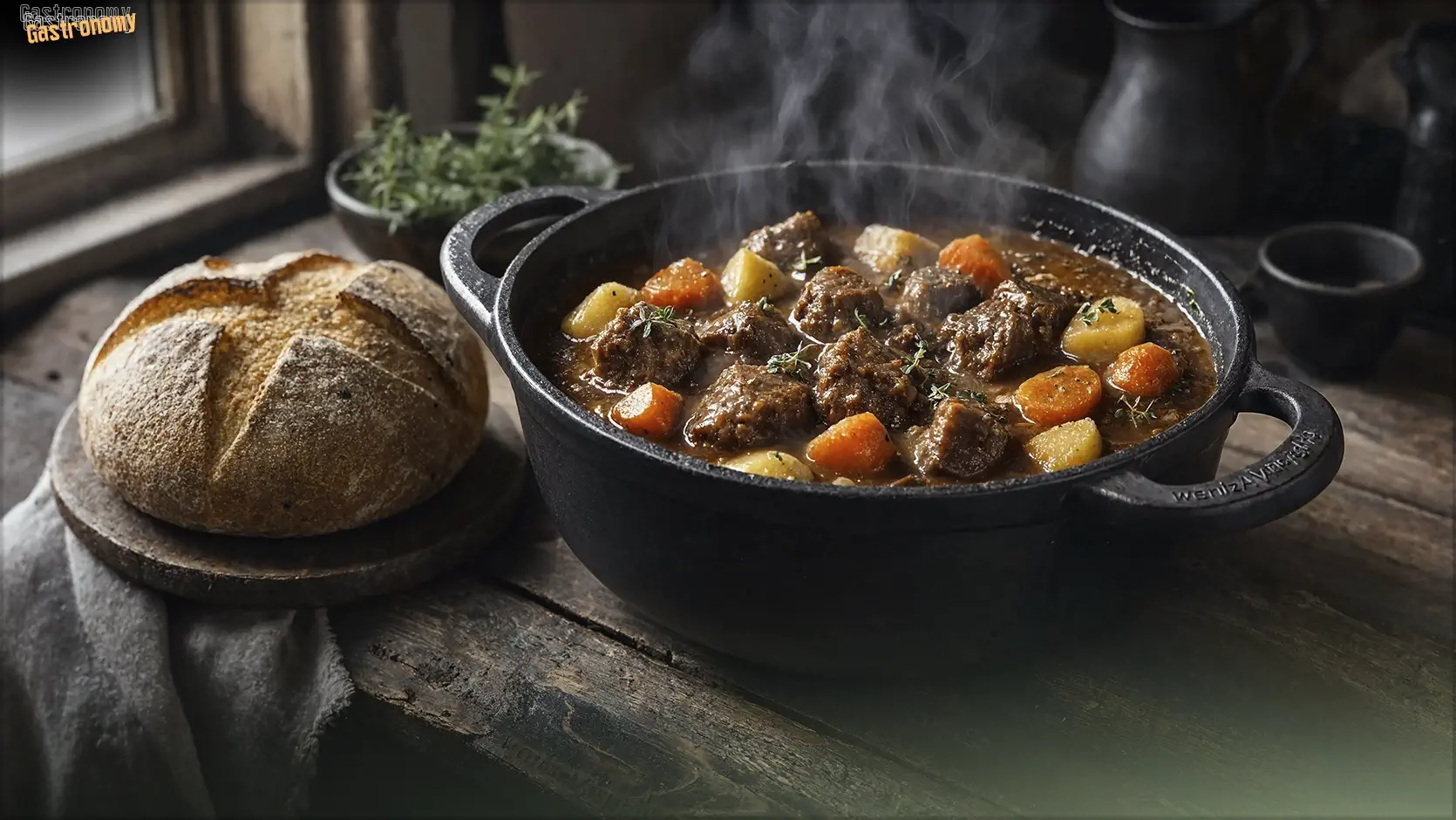
The Promise Before the Recipe
Before there were cookbooks, before there were measured cups and written instructions, there was a promise. It was the promise made by a mother to her family in a small farmhouse kitchen, where the wind rattled the window frames and the last of the potatoes sat in a sack in the corner. The promise was simple: nothing good will be wasted. The tough cut of meat, the last of the root vegetables, the herbs from the garden — all of it will go into one pot, and all of it will become dinner. And somehow, in the alchemy of time and heat, it will taste like the finest thing in the world.
This is the true origin of Irish stew. It is not a recipe in the modern sense. It is not a set of instructions to be followed precisely. It is a philosophy of cooking — the belief that nourishment does not require luxury, that comfort does not require complexity, and that the humblest ingredients, given time and attention, become something sacred. The pot on the fire was not just cooking food. It was keeping a promise.
The Ingredients of Necessity
The beauty of traditional Irish stew lies in its brevity. There is no long list of ingredients, no exotic imports, no elaborate technique. There is only what the land gave, what the family could afford, and what survived in the cellar through the autumn months. This is the stew of the dark earth's harvest, made visible in a bowl.
The classic version asks for only four things: lamb, potatoes, onion, and thyme. Some families add carrots, some add turnips, some add a splash of broth. But the heart of the stew is the same everywhere: a tough, inexpensive cut of meat — usually lamb neck or shoulder, the parts that require long, slow cooking to become tender — layered with potatoes that dissolve into the broth, onions that sweeten with time, and a few sprigs of thyme that give the whole pot its quiet, herbal soul.
Why One Pot
The one-pot meal is not just convenient; it is philosophical. In a household where fuel was precious and time was short, the one-pot method made sense. You put everything in together, set the pot over the fire or in the oven, and let time do the work. No stirring, no watching, no elaborate technique. The heavy lid kept the moisture in, the gentle heat broke down the tough fibres of the meat, and the potatoes released their starch to thicken the broth naturally.
This is the same principle as the stockpot simmering for twelve hours — the belief that heat and patience can transform the humble into the sublime. But where the stockpot is an act of waiting, the stew is an act of feeding. It is the meal that comes after the waiting is done, the reward for the hours of gentle heat.
The Recipe: Traditional Irish Stew
What you need:
- 1 kg lamb neck or shoulder, cut into chunks
- 6 medium potatoes, peeled and quartered
- 2 large onions, sliced
- 2 carrots, sliced (optional, but traditional in many families)
- A few sprigs of fresh thyme
- 500 ml lamb or vegetable stock
- Salt and black pepper
- A knob of butter (optional, for richness)
How to make it:
- Season the meat: Pat the lamb dry and season generously with salt and pepper. This is the only seasoning the meat will get, so do it well.
- Layer the pot: In a heavy, oven-proof pot with a tight-fitting lid, start with a layer of sliced onion on the bottom. Add a layer of potatoes, then a layer of lamb. Repeat until all ingredients are used, finishing with a layer of potatoes on top. Tuck the thyme sprigs between the layers.
- Add the liquid: Pour in the stock. It should come about halfway up the layers, not cover them. The potatoes and meat will release their own juices as they cook.
- Cover and cook: Put the lid on tightly. Cook in a preheated oven at 160°C (325°F) for 2.5 to 3 hours, until the meat is falling-apart tender and the potatoes have begun to dissolve into the broth.
- Rest and serve: Let the stew rest for ten minutes before serving. The broth will thicken slightly as it cools. Serve with a round of soda bread for dipping.
Why Soda Bread Belongs Beside It
No Irish stew is complete without soda bread. The two were made for each other. The stew is slow; the bread is fast. The stew requires hours; the bread requires thirty minutes from start to plate. Together, they represent the full rhythm of the Irish kitchen: the long patience of the pot, and the quick, satisfying warmth of fresh bread.
Soda bread is also a bread of necessity. There is no yeast, no rising, no kneading. Just flour, buttermilk, baking soda, and salt. The acid in the buttermilk reacts with the baking soda to create lift, and the whole thing comes together in minutes. It is the bread of the farm kitchen, made fresh for dinner and eaten the same day. By the next day, it is stale — but that is fine, because you will make another loaf tomorrow.
The Recipe: Soft Soda Bread
What you need:
- 450 g plain flour, plus extra for dusting
- 1 tsp baking soda
- 1 tsp salt
- 400 ml buttermilk
How to make it:
- Mix the dry: Sift the flour, baking soda, and salt into a large bowl. Make a well in the centre.
- Add the buttermilk: Pour in the buttermilk and mix gently with your hands until a soft dough forms. Do not overwork it — the less you handle it, the more tender the bread will be.
- Shape and score: Turn the dough onto a floured surface and shape it into a round. Place on a baking tray and cut a deep cross into the top with a sharp knife. This helps the heat penetrate and allows the bread to bake evenly.
- Bake: Bake in a preheated oven at 200°C (400°F) for 30–35 minutes, until the loaf sounds hollow when tapped on the bottom.
- Cool briefly: Wrap the hot loaf in a clean tea towel for five minutes to soften the crust. Serve warm, broken into quarters, with butter.
The Table That Feeds the Memory
When you sit down to a bowl of Irish stew with a chunk of soda bread in your hand, you are not just eating dinner. You are participating in a tradition that stretches back centuries. You are eating the same meal that was eaten in farmhouses and cottages, in good years and hard years, in every season but especially in autumn, when the harvest was in and the nights were growing long.
The stew feeds the body. The bread feeds the body. But together, they feed something deeper. They feed the memory of everyone who ever made this meal before you, everyone who kept the promise that nothing good would be wasted. And when you make it yourself, when you layer the lamb and the potatoes and the thyme into the pot, you are keeping that promise too. You are saying, to the past and to the future: this mattered. This nourished us. This was enough.
Для комментирования войдите или зарегистрируйтесь.