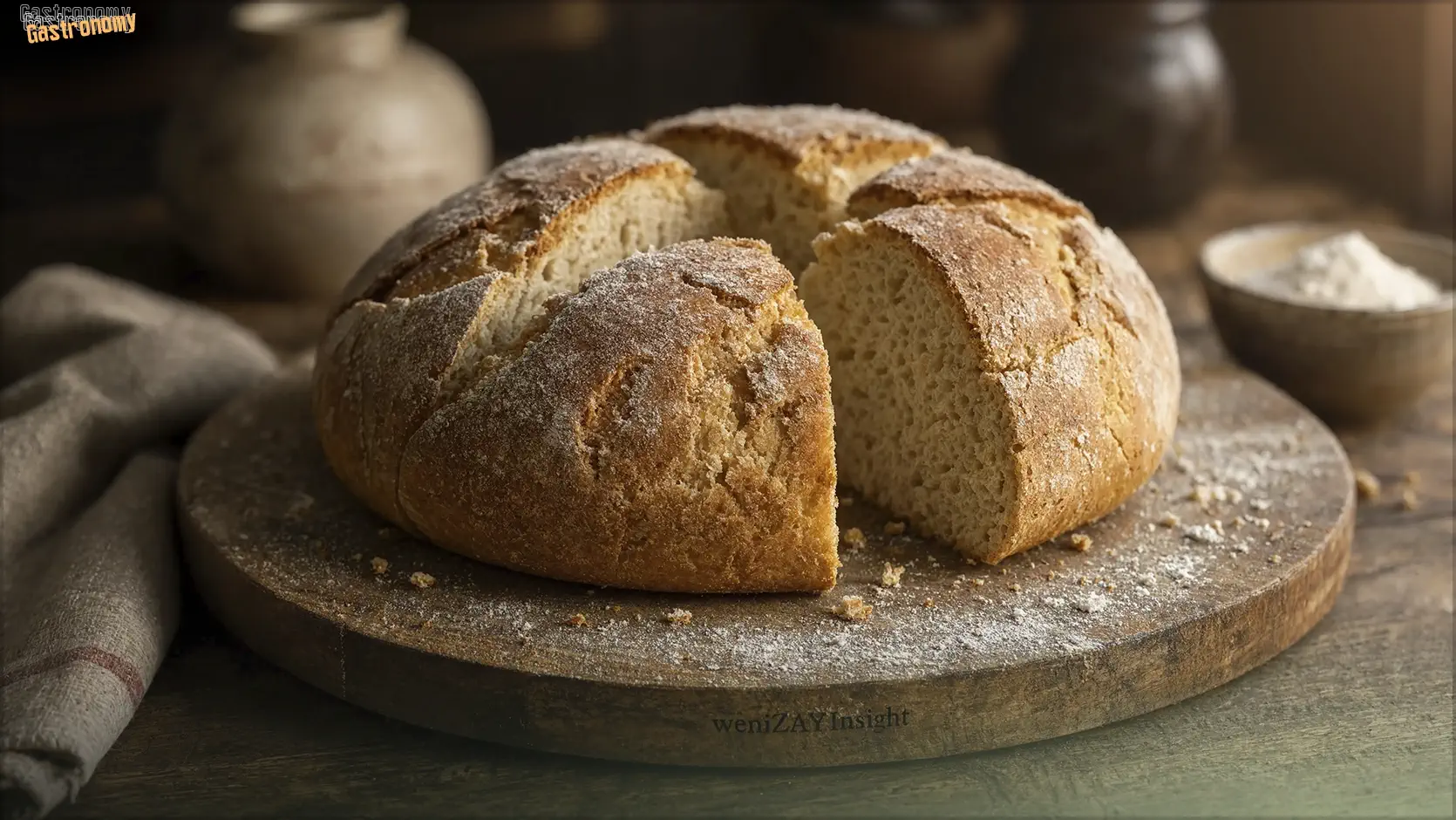
The Bread That Needs No Waiting
There is a bread that does not ask for your afternoon. It does not need a warm corner to rise, or a fold at midnight, or a starter you have been feeding like a small, demanding pet. It asks for four ingredients, one bowl, and thirty minutes of your life. And when it comes out of the oven — golden, cracked, smelling of warm grain and the faintest tang of buttermilk — it is as honest a loaf as anything that spent two days proving. This is soda bread, the fastest bread you will ever bake, and possibly the one you will make most often.
Soda bread belongs to the tradition of the Irish farmhouse table, where bread was made fresh each day and eaten the same day, and where the idea of "waiting for bread" was a luxury no working kitchen could afford. But it also belongs to anyone who has ever looked at a nearly empty cupboard and thought: I can still make something good.
A Short History of the Quick Loaf
Soda bread was born in the 1840s, when bicarbonate of soda first became widely available in Ireland. It arrived into a country of soft wheat — wheat too low in gluten for the airy, yeasted loaves of France or Italy. Irish flour made heavy bread unless it was leavened another way. The combination of soft wheat, buttermilk, and baking soda was the answer: a bread that needed no kneading, no long fermentation, and no oven that held heat all day. It could be made in a cast-iron pot over the fire, and it was.
For generations, soda bread was the daily bread of rural Ireland. Every household made its own, and the deep cross cut into the top was as familiar as the door. The bread was made in the morning and gone by night. No one thought of it as a recipe. It was simply what you did when there was flour in the tin and milk in the pail.
Why It Always Works
The secret of soda bread is a small, reliable piece of chemistry. Bicarbonate of soda is an alkali. Buttermilk is an acid. When they meet, in the presence of moisture, they react instantly, releasing bubbles of carbon dioxide. Those bubbles lift the dough. There is no yeast, no waiting, no fermentation — just an immediate chemical rise that begins the moment the ingredients touch and finishes in the heat of the oven.
This is why the method has one rule above all others: handle the dough as little as possible. Overworking develops gluten, which makes the crumb tough, and it also bursts the bubbles the reaction has already created. The best soda bread is mixed with a light hand and a forgiving heart. If your loaf looks a little rough, a little uneven, a little wild on top — you did it right.
The Recipe: Classic Soda Bread
What you need:
- 450 g plain flour, plus extra for dusting
- 1 tsp bicarbonate of soda (baking soda)
- 1 tsp salt
- 400 ml buttermilk
How to make it:
- Preheat and prepare: Heat the oven to 200°C (400°F). Lightly flour a baking tray or line it with parchment.
- Mix the dry: Sift the flour, bicarbonate of soda, and salt into a large bowl. Make a well in the centre.
- Add the buttermilk: Pour it into the well and mix with one hand, fingers slightly open, until a soft, slightly sticky dough forms. Stop as soon as it comes together.
- Shape and score: Turn the dough onto a floured surface, gently pat it into a round about 4 cm thick, and place on the tray. Cut a deep cross into the top with a floured knife.
- Bake: 30–35 minutes, until the loaf is golden and sounds hollow when tapped on the bottom.
- Soften the crust: Wrap the hot loaf in a clean tea towel for five minutes. Break into quarters and serve warm with butter.
The Variations
The classic white soda bread is only the beginning. Once you understand the basic ratio — flour, soda, salt, acid — you can bend it in almost any direction:
- Brown soda bread: Replace half the plain flour with wholemeal. The loaf becomes denser, nuttier, and more satisfying. This is the everyday version in many Irish homes.
- Sweet soda bread with raisins: Add 100 g of raisins or sultanas and a tablespoon of sugar. This version, sometimes called spotted dog, is a tea-time favourite and toasts beautifully.
- Oat-crusted soda bread: Scatter rolled oats over the top before baking for a rustic, toasty crust. You can also replace up to 50 g of flour with oats for a chewier crumb.
- Cider or stout soda bread: Replace part of the buttermilk with dry cider or a dark stout. The bread picks up a faint, complex depth that pairs wonderfully with a pot of stew.
- Seed soda bread: Stir in a handful of mixed seeds — sunflower, pumpkin, flax — for texture and a quiet nuttiness.
How to Keep It
Soda bread is honest about its lifespan: it is at its best the day it is baked, while the crumb is still soft and the crust still warm. By the next day it has begun to dry. This is not a flaw — it is simply the nature of an un-yeasted, un-preserved loaf. The good news is that day-old soda bread toasts magnificently, and buttered toast from yesterday's loaf is breakfast worth planning for.
If you want it to last longer, slice the cooled loaf, wrap it well, and freeze it. Slices can go straight from freezer to toaster, and you will have honest, homemade bread on demand — which, for a loaf this easy, feels almost like cheating.
The Fastest Gift You Can Give
There is a reason soda bread survives. In a world full of complicated recipes and slow, demanding bakes — where sourdough asks for days of your life — soda bread asks for almost nothing. And yet it gives everything a bread should give: warmth, substance, the smell of a kitchen where something good is happening. It is the loaf you make when you have no plan and someone is coming. It is the proof that generosity does not have to be slow.
Для комментирования войдите или зарегистрируйтесь.