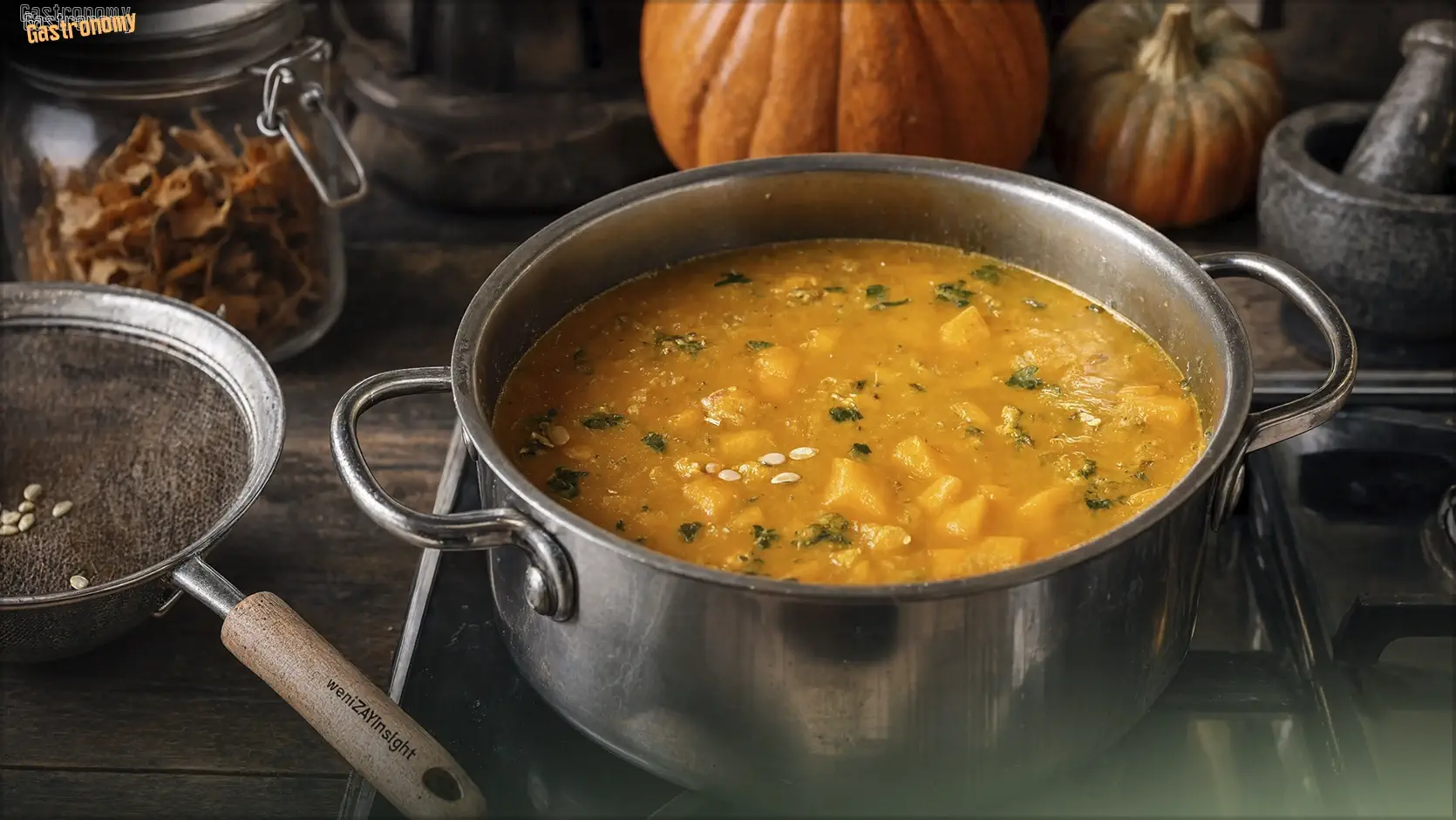
The Pumpkin Has One More Gift
You have roasted the flesh. You have toasted the seeds. You have made the meal, filled the kitchen with the smell of caramelised squash and sage, and fed the people you love. And now you stand at the counter with a pile of pumpkin peels, a handful of stringy trimmings, and a bowl of things you were about to compost. Most people throw them away. They are wrong.
Those peels and strings are not waste. They are the last gift of the pumpkin, and they are waiting to become something you have probably never made: a light, golden, deeply savoury broth that tastes like autumn itself. This is pumpkin scrap broth, and it is one of the easiest, most rewarding things you can make in an autumn kitchen. It costs nothing. It wastes nothing. And it turns any soup, risotto, or sauce into something deeper and more complete.
Why Scrap Broth Matters
Vegetable scrap broth is one of the oldest techniques in the kitchen. Before refrigeration, before supermarkets, before the idea that food waste was acceptable, every household knew that the peels, ends, and trimmings of vegetables still held flavour, nutrients, and life. Simmered gently in water, they gave up everything they had, and the liquid became the foundation of the next meal.
This is the same principle as the stockpot's slow extraction — heat and time drawing depth from humble ingredients. But where a bone broth asks for hours and marrow bones, a pumpkin scrap broth asks for one hour and whatever you were about to throw away. It is the gentlest, most forgiving stock you can make, and it rewards you with a liquid the colour of weak tea and the flavour of the whole autumn garden.
What to Save and What to Skip
Not every part of the pumpkin is equally good for broth. Here is what to save, and what to skip:
- Save the peels: The skin of the pumpkin is rich in flavour and colour. Even if you peeled the flesh for roasting, save the peels for the stock pot. They will give the broth its golden hue.
- Save the seed pulp: The stringy mass that holds the seeds is flavourful and full of body. After you remove the seeds for toasting, save the pulp for the broth.
- Save the trimmings: Any tough ends, stem bases, or imperfect bits you trim from the pumpkin can go into the stock pot. Nothing needs to be pretty.
- Skip the seeds for broth: The seeds themselves are better toasted and eaten. If you have a few extras, they can go in the broth for body, but do not waste good seeds on stock.
- Skip anything mouldy or rotten: If any part of the pumpkin is spoiled, compost it rather than simmering it. Scrap broth is for good, fresh scraps — not for salvaging food past its prime.
The Recipe: Golden Pumpkin Scrap Broth
What you need:
- Peels, strings, and trimmings from one medium pumpkin
- 1 onion, roughly chopped (optional, but adds depth)
- 1 carrot, roughly chopped (optional)
- 2 cloves garlic, crushed
- 1 bay leaf
- 6 black peppercorns
- A few sprigs of thyme or parsley stems
- 1 tsp sea salt, or to taste
- About 2 litres cold water
How to make it:
- Gather the scraps: Collect the pumpkin peels, strings, and trimmings in a large pot. Add the onion, carrot, garlic, bay leaf, peppercorns, and herbs if using.
- Add the water: Pour in enough cold water to cover everything by a few centimetres. Start with about 2 litres; you can add more if needed.
- Bring to a simmer: Heat gently until the water just begins to simmer. Do not boil; a bare simmer keeps the broth clear and the flavour clean.
- Simmer gently: Cook for 45 minutes to 1 hour, until the liquid is golden and fragrant. The peels will be soft and the broth will smell like the whole autumn garden.
- Strain: Pour the broth through a fine sieve or cheesecloth into a clean bowl or pot. Press the solids gently to extract every drop of flavour. Discard the solids (or compost them).
- Season and store: Taste and adjust the salt. Use immediately, refrigerate for up to 4 days, or freeze in portions for up to 3 months.
What to Do With the Broth
Once you have your golden pumpkin broth, the question becomes what to make with it. The answer is almost anything that needs liquid and depth:
- Pumpkin soup: The most natural use. Add roasted pumpkin flesh to the broth, blend until smooth, and finish with cream or olive oil. The broth deepens the flavour and gives the soup body.
- Risotto: Use the broth as the cooking liquid for a pumpkin or mushroom risotto. Its golden colour and savoury depth make the rice sing.
- Grain bowls: Cook rice, barley, or farro in the broth instead of water. The grains absorb the flavour, and the dish becomes more than a side.
- Sauces and pan gravies: Use the broth as the base for pan sauces after roasting meat or vegetables. It adds depth without heaviness.
- Braised vegetables: Braise greens, beans, or root vegetables in the broth for a simple, flavourful side dish.
The broth is light enough to work in delicate dishes and flavourful enough to anchor hearty ones. It is the quiet backbone of the autumn kitchen, and it cost you nothing but the scraps you were going to throw away.
The Kitchen That Wastes Nothing
There is a quiet dignity in a kitchen that uses everything. Not out of stinginess, but out of respect — respect for the food, for the season, and for the work that went into growing it. The pumpkin gave you the flesh, the seeds, and the skin. You honoured the flesh by roasting it. You honoured the seeds by toasting them. And now, by simmering the skin and strings into broth, you honour the whole vegetable.
This is the last gift of the pumpkin, and it is the gift that keeps giving. Because the broth you make today will become the soup you serve tomorrow, the risotto you make next week, the sauce that finishes the Sunday roast. The pumpkin does not end when the meal is done. It continues, in the broth, in the next dish, in the next season. And that is the deepest lesson of the autumn kitchen: nothing good is wasted, and everything has one more gift to give.
Для комментирования войдите или зарегистрируйтесь.