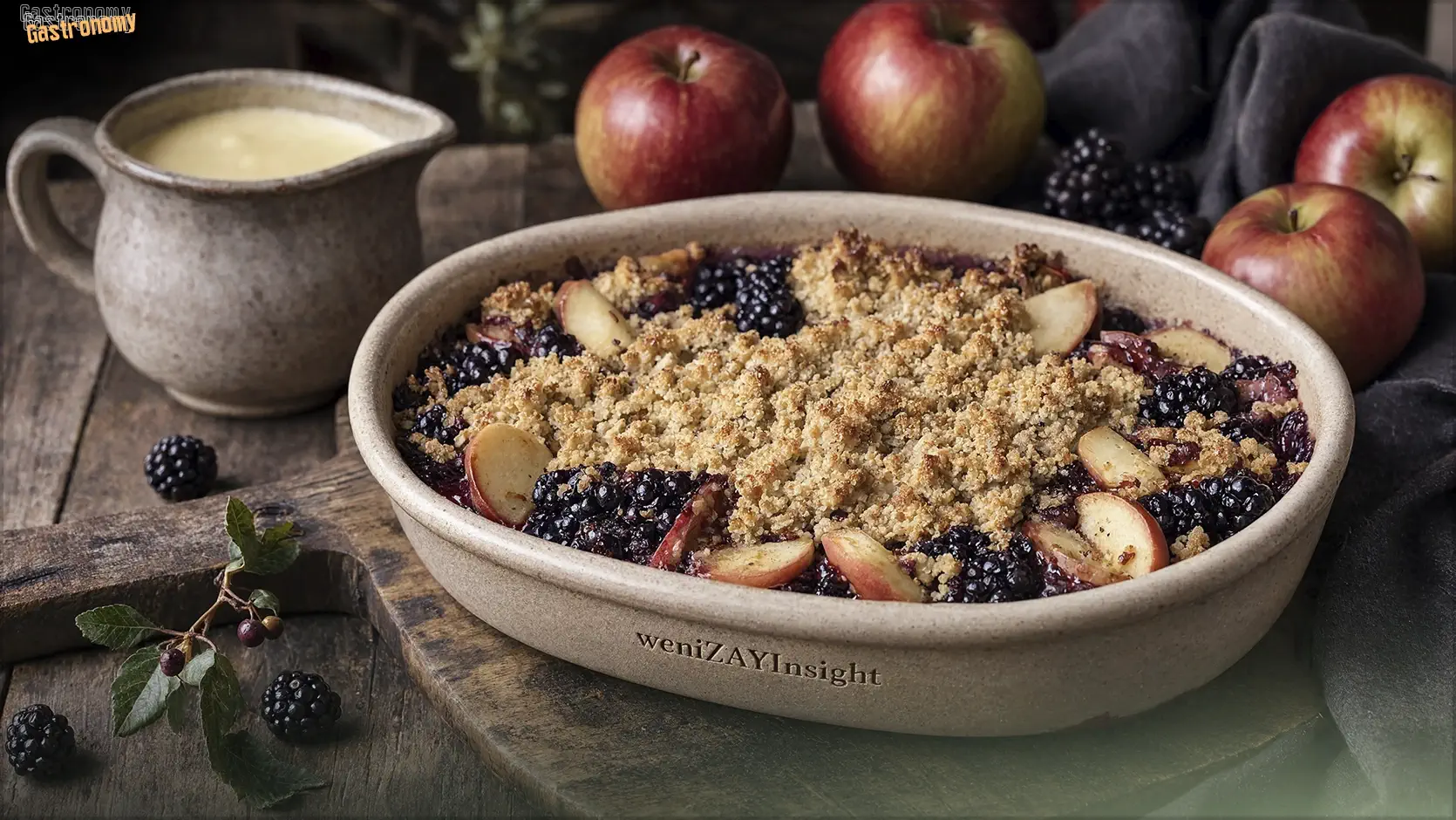
The Meeting of Two Landscapes
Some dishes belong to a single place. A roast belongs to the Sunday table. A soup belongs to the kitchen on a cold evening. But blackberry and apple crumble belongs to two places at once — the wild hedgerow and the cultivated orchard, the place where the bramble tangles along the field edge and the place where the apple trees stand in their patient rows. It is the dish where those two landscapes agree to meet, and it is the most honest dessert of the British autumn.
The blackberry brings the wildness. It is tart, dark, and a little untamed, with the sharp edge of the hedgerow and the faint taste of the thorns it grew on. The apple brings the comfort. It is sweet, familiar, and round, with the steady flavour of the orchard and the memory of every crumble that came before. Together, they balance each other perfectly — the blackberry's acidity cutting through the apple's sweetness, the apple's softness giving the blackberry something to lean against. Neither is complete without the other.
Why This Pairing Works
The genius of blackberry and apple is not just flavour, though the flavour is superb. It is also texture, chemistry, and season. The blackberry is high in acid and low in pectin; the apple is lower in acid and high in pectin. When cooked together, the apple's pectin gives the filling a gentle set, while the blackberry's acid keeps the whole thing bright and prevents it from becoming cloying. The result is a filling that is neither too sweet nor too sharp, neither too loose nor too firm. It is the kind of balance that no single fruit could achieve alone.
The season is also part of the pairing. Blackberries ripen in the hedgerows from August through October, and apples come down from the orchard at the same time. The two fruits are ready together, and the crumble is the natural way to bring them together. It is a dish that could only exist in autumn, when the hedgerow and the orchard are both giving their last.
Choosing the Right Apple
The apple matters as much as the blackberry, and the wrong apple can make or break the dish. The classic choice is a cooking apple — sharp, firm, and high in pectin — rather than a sweet dessert apple. Here is how to choose:
- Bramley: The classic British cooking apple. Large, green, and very sharp, it breaks down beautifully in cooking and gives the crumble its traditional tang. If you can get Bramleys, use them. They are the best choice for this dish.
- Other cooking apples: If Bramleys are not available, look for any sharp cooking variety — Grenadier, Newton Wonder, or Lord Derby. The key is acidity and firmness, not sweetness.
- Dessert apples as a substitute: If you have no cooking apples, you can use a sharp dessert variety like Cox's Orange Pippin or Braeburn. Reduce the sugar slightly, since these are sweeter than cooking apples. The crumble will be less tangy but still delicious.
- Avoid very sweet apples: Gala, Fuji, and Golden Delicious are too sweet and too soft for this dish. They will make the filling cloying and the texture mushy. Save them for eating raw.
For more on heritage apples and how to choose them, see the guide to the autumn orchard. And for the philosophy of the crumble itself — the imperfect, butter-rubbed, beautifully rough topping — see the crumble manifesto.
The Recipe: Classic Blackberry and Apple Crumble
What you need for the filling:
- 400 g blackberries, rinsed
- 2 large cooking apples (about 500 g), peeled, cored, and sliced
- 75 g caster sugar (adjust to taste)
- 1 tbsp water
What you need for the crumble topping:
- 150 g plain flour
- 75 g cold butter, cubed
- 50 g caster sugar
- 40 g rolled oats (optional, for texture)
How to make it:
- Preheat: Heat the oven to 190°C (375°F).
- Make the filling: Place the blackberries, sliced apples, sugar, and water in a saucepan. Cook gently for 5–8 minutes until the fruit has softened slightly and released some juice. Do not overcook; you want the fruit to hold some shape.
- Transfer: Tip the fruit into a baking dish (about 23 cm / 9 inch round, or a similar-sized oval dish).
- Make the topping: In a bowl, rub the cold butter into the flour with your fingertips until the mixture resembles coarse breadcrumbs. Stir in the sugar and oats.
- Top and bake: Scatter the crumble mixture evenly over the fruit. Bake for 30–35 minutes, until the topping is golden and bubbling at the edges.
- Rest and serve: Let the crumble stand for 5 minutes before serving. Serve warm with custard, cream, or ice cream.
The Dish That Tastes Like September
There is a reason blackberry and apple crumble is the dessert of the British autumn, and it is not just that the ingredients are in season. It is that the dish captures the feeling of the season — the generosity of the hedgerow, the comfort of the orchard, the sense that the year is giving its last and best gifts before the cold sets in. It is a dish that tastes like walking home with a basket of blackberries, like the smell of apples in a barn, like the first evening you lit the kitchen fire.
When you make this crumble, you are not just baking. You are participating in a tradition that goes back generations, in every kitchen that ever looked at the hedgerow and the orchard and decided to bring them together. You are making the dish that says: the year is closing, but it is closing beautifully. And you are serving it warm, with custard, to the people you love. That is the most honest dessert there is.
Для комментирования войдите или зарегистрируйтесь.