The Tyranny of the Perfect Crust
There is a specific, quiet anxiety reserved for those who attempt to bake a perfect lattice pie. The dough must be ice-cold, the rolling pin perfectly floured, the strips of pastry measured and woven with the precision of a carpenter. It is a beautiful thing, but it is exhausting. It demands that you be flawless. If your hands are too warm, if you work the dough too much, if your weave is slightly asymmetrical, the illusion is broken.
But the autumn crumble and the American cobbler ask nothing of your perfection. They are the humble cooking of the cold months, born in kitchens where time was short and the oven was the only source of heat. They are an imperfect dessert by design, and in their roughness, they offer a profound psychological relief.
The Primal Joy of Rubbing In
When you make a crumble, you do not use a food processor. You do not use a stand mixer. You use your hands. You take cold, cubed butter and rub it into plain flour with your fingertips. It is a deeply tactile, grounding exercise. You are feeling the temperature of the fat, watching it transform from solid blocks into coarse, uneven breadcrumbs.
This method, the cornerstone of British baking, connects us to a long line of grandmothers who stood at scarred wooden tables, rubbing fat into flour while the wind rattled the windowpanes. It is a rhythm that slows the heart rate. You are not engineering a pastry; you are simply preparing the earth for the fruit.
The Method for the Anxious Baker
To embrace the freedom of the crumble, approach the process not as a science, but as a loose, intuitive ritual:
- Prepare the fruit honestly: Peel and chop your apples, pears, or plums. Toss them with a little sugar, a heavy pinch of cinnamon, and a squeeze of lemon. Do not worry about uniformity in the chop; the uneven pieces will cook at different rates, creating a complex texture.
- Rub with intention: Add your cold butter to the flour. Rub it in until it looks like a messy landscape of coarse sand and pea-sized lumps. Those little lumps of pure butter are the secret to a crispy top.
- Scatter, do not press: Stir a handful of sugar (and oats, if you like) into the flour mixture. Then, simply scatter it over the fruit. Let it fall where it may.
- Bake until it bubbles: Put it in the oven and walk away. You will know it is ready when the fruit juices are bubbling thickly around the edges and the top is a deep, caramelized gold.
The Courage to Serve It Ugly
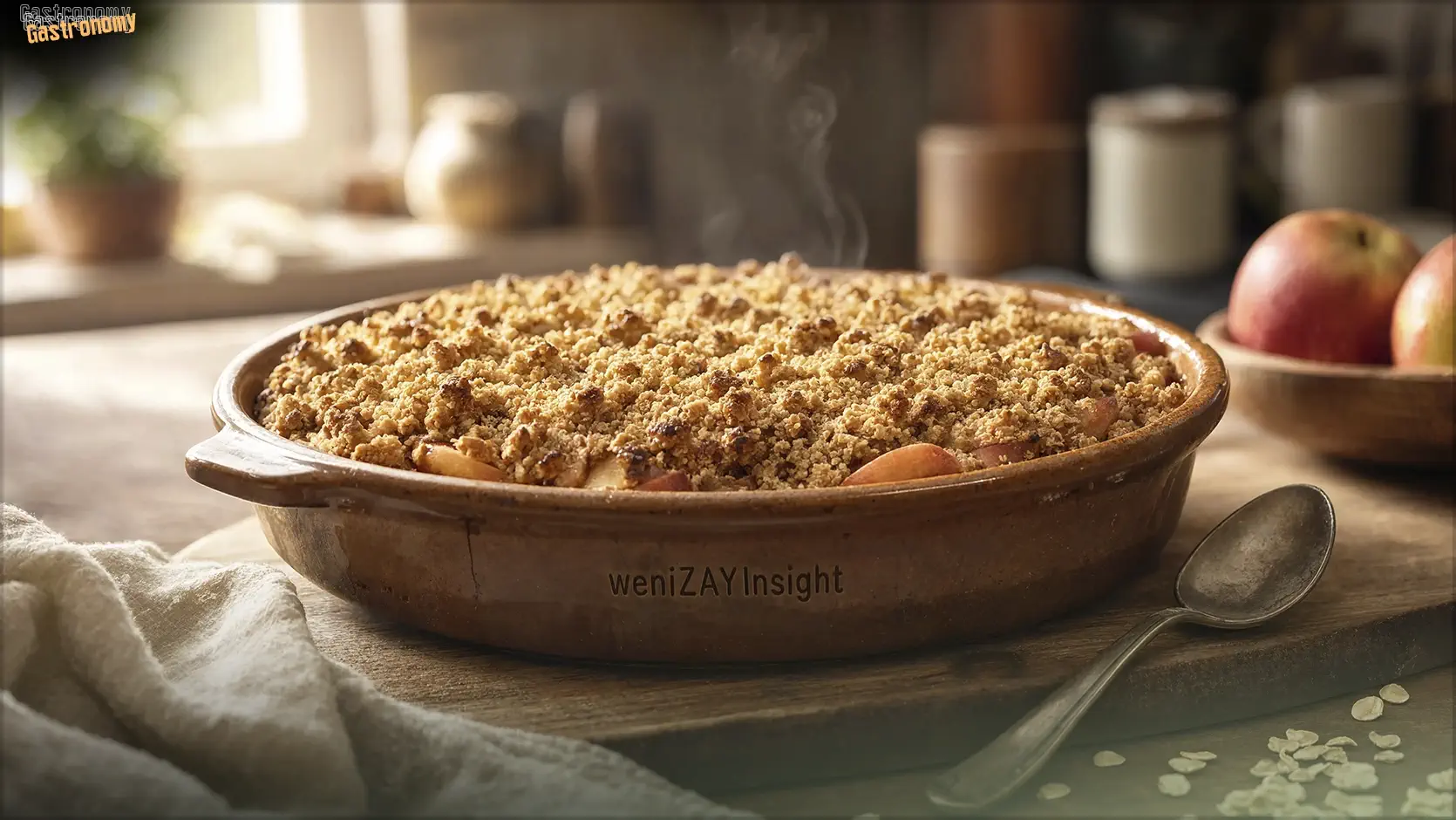
When you pull the dish from the oven, it will not look like a magazine cover. It will look like a beautiful disaster. The juices will have boiled over, caramelizing on the sides of the ceramic dish. The top will be a chaotic landscape of golden peaks and pale, soft valleys. It is entirely asymmetrical.
And that is exactly why we love it. The apple crumble does not pretend to be something it is not. It doesn't hide behind a flawless crust or a perfect glaze. It offers itself up exactly as it is: warm, messy, deeply sweet, and entirely honest. When you spoon it into bowls and the steam rises, carrying the scent of baked apples and browned butter, you realize that perfection was never the point. The point was the warmth. The point was the sharing. The point was the permission to be rough.
Для комментирования войдите или зарегистрируйтесь.