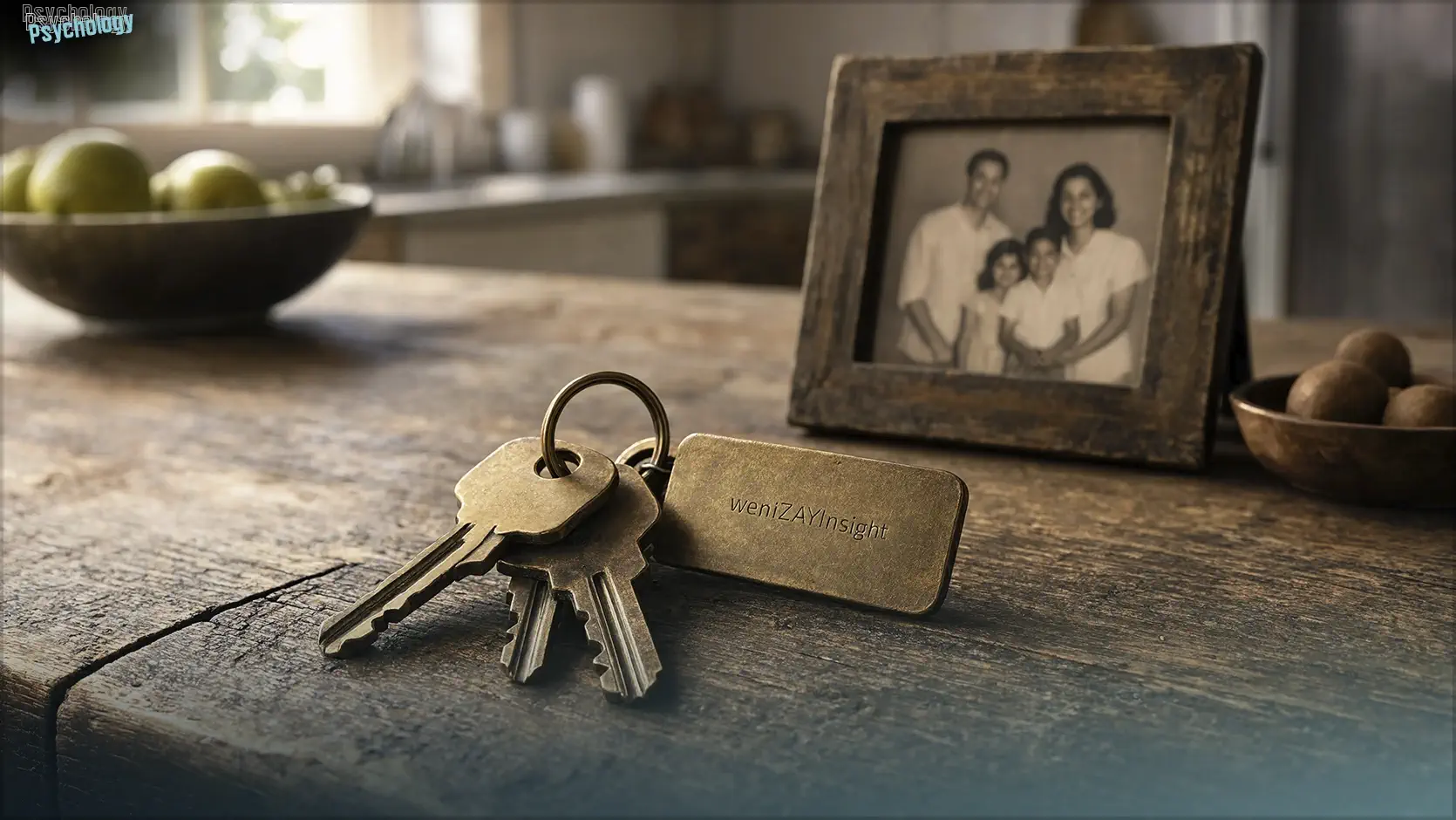
The Door That Was Never Allowed to Close
In many families, love has an architectural feature: the always-open door. No locked bedrooms. No unanswered phone calls. No weekends that belong only to you. In rural Ireland, the door was literally left on the latch. In Mediterranean homes, Sunday dinner was not an invitation; it was a standing verdict. In South Asian households, the question "Why didn't you pick up?" carries the weight of a court summons. The open door is not just a habit; it is a moral position. It says: if you love us, you have nothing to hide and nowhere more important to be.
For many people, this felt like warmth for a long time. Then, at some point — maybe at twenty-five, maybe at forty — the warmth began to feel like a low-grade fever. The always-open door stopped feeling like intimacy and started feeling like surveillance. And the moment you reached for the handle, you felt something far worse than anger from the other side: you felt the guilt of the betrayer.
Enmeshment: When Closeness Has No Edges
In psychology, enmeshment describes a family system in which the boundaries between individuals are so blurred that members cannot tell where one person's feelings end and another's begin. It is not the same as closeness. Healthy closeness is two people choosing to stand near each other; enmeshment is two people who were never taught they are separate.
In an enmeshed family, a child's role is to regulate the parent's emotions. If the mother is anxious, the child must call more often. If the father is lonely, the adult child must visit, regardless of their own needs. Saying no is not experienced as a limit; it is experienced as an abandonment. And that is the trap: the child grows up believing that family loyalty and personal freedom are mutually exclusive, that you must choose one, and that the correct choice is always the family.
Why This No Feels Different From All Other Nos
Setting a boundary with a colleague is uncomfortable. Setting a boundary with a friend can sting. But setting a boundary with a parent activates something far older and far deeper: the child's survival terror of abandonment.
When you were small, your parents' approval was not a preference; it was oxygen. The brain of a child literally cannot survive rejection from its primary attachment figures. And so, the nervous system built a program: keep them happy, keep them close, keep the door open, or die. That program does not automatically update when you turn thirty. It is still running, still scanning for the parent's displeasure, still sounding the alarm when you reach for the handle.
This is why the body responds so violently to the idea of saying no to family. The chest tightens. The stomach churns. The guilt arrives not as a thought but as a physical wave, because the nervous system is processing the boundary not as an adult choice but as a child's catastrophe.
The Guilt Catalogue
Generational guilt comes in recognizable flavours. Learning to name them is the first step toward loosening their grip:
- The sacrifice guilt: "After everything they gave up for me." This guilt leverages the parent's real or narrated suffering to make the child's independence feel like ingratitude. The truth: gratitude and boundaries are not opposites. You can honour the sacrifice without continuing to pay for it with your autonomy.
- The cultural guilt: "In our culture, this is how we show respect." This guilt is powerful because it fuses personal identity with collective expectation. But culture is not static; it evolves. And the children who question the rules are often the ones who save the next generation from the same suffocation.
- The fragility guilt: "If I say no, they will fall apart." This guilt casts the parent as incapable of surviving the child's independence. The truth: parents who collapse at a boundary are often parents who were never required to develop their own emotional self-regulation — and your compliance is the thing preventing them from learning.
- The loyalty guilt: "Talking about this feels like a betrayal." This guilt keeps the family sealed. But naming a dynamic is not a betrayal; it is the beginning of honesty. And honesty, not silence, is the actual foundation of loyalty.
How to Build the Gate Without Burning the House
The goal is not to sever the bond. The goal is to transform it from a fused cable into two distinct threads that can intertwine by choice rather than compulsion. This is what the psychologist Murray Bowen called emotional differentiation — the ability to remain emotionally connected to your family while maintaining a clear, separate self.
The Grief on the Other Side
Here is the part no one warns you about: even when the boundary is right, you will grieve. You will grieve the fantasy of the family that did not need a gate. You will grieve the version of yourself that could tolerate the open door without flinching. You will grieve the uncomplicated love you had before you understood the word enmeshment.
But on the other side of that grief, something unexpected grows. The phone call on Sunday — the one you chose, not the one you owed — becomes warmer than the daily check-in ever was. The visit home, now boundaried by a departure date you set in advance, becomes a gift you offer rather than a debt you pay. The door is still there. It can still open. But now, for the first time, you are the one holding the key.
Для комментирования войдите или зарегистрируйтесь.